Peripheral Nerve Injury
Novel Biodegradable Regeneration-Type Neural Interfaces for High-Resolution Stimulation and Recording from Peripheral Nerves
We aim to develop novel, high-site-count microelectrodes that are optimized for electrically stimulating and recording from regenerated peripheral nerves. These devices will facilitate the creation of next-generation neuroprosthetic systems for restoring function to upper- and lower-limb amputees.
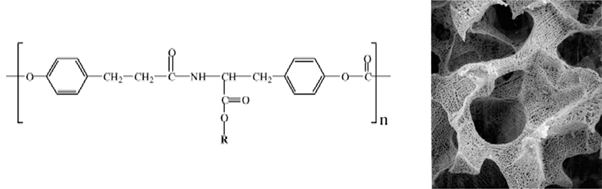
Chemical structure of desaminotyrosyl-tyrosine alkyl esters derived polycarbonate, abbreviated ‘poly(DTR carbonate)’. The carboxylic acid terminal group is protected by an alkyl ester, which can be regarded as a pendent chain. The structure of the alkyl esters is indicated by the following nomenclature convention: DT, desaminotyrosyl-tyrosine ester; DTE, desaminotyrosyl-tyrosine ethyl ester; DTB, desaminotyrosyl-tyrosine butyl ester; DTH, desaminotyrosyl-tyrosine hexyl ester; DTO, desaminotyrosyl-tyrosine octyl ester; DTD, desaminotyrosyl tyrosine dodecyl ester. These particular monomers are most commonly used in the synthesis of tyrosine-derived polymers (Right) Porous scaffold fabricated from poly (DTE carbonate) with a bimodal distribution of macro- and micro-pores. Macropores (212–425 mm) are the impressions of the salts, the micropores (about 1 to 10 mm) are caused by the formation of frozen solvent crystals during cooling (Bourke & Kohn, 2003).
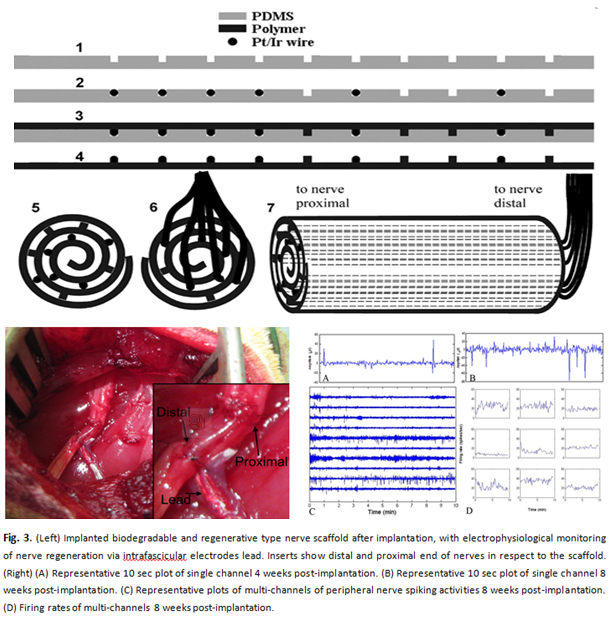
Intrafascicular Electrode & Peripheral Nerve Signal
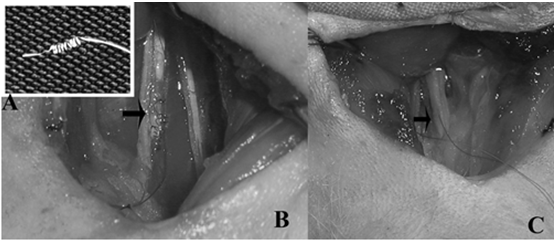
1. We aim to study long-term recording of nerve signal by modified intrafascicular electrodes in rabbits. Methods for long-term recording of peripheral nerve activity via intrafascicular electrodes have not been optimized. Intrafascicular electrodes with a spring-like structure demonstrated superior potential for long-term electrophysiologic monitoring over straight electrodes.
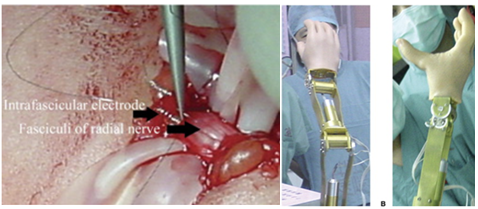
2. The residual motor pathways after amputation have not been fully elucidated. We sampled potentials from peripheral nerve stumps with intrafascicular electrodes to study residual motor transmission and explore the feasibility of nerve signal-controlled artificial limbs. The long-term amputee was able to generate motor neuron activity related to phantom limb movement. Intrafascicular electrodes can be used to monitor residual motor nerve activity in the stump and the amplitude may predict successful control of artificial limbs.
Awards and Recognition
Finalist of the Best Overall Poster Award of American Academy of Orthopaedic Surgeons (AAOS), 2008
Recipient of Annual Research Award of American Association for Hand Surgery (AAHS) (Three awarded nationally), 2008
Guest Editor
International Journal of Molecular Sciences (Impact Factor – 2.464, 2012): Special issue on Neurological Injuries’ Monitoring, Tracking and Treatment
BioMed Research International (Impact Factor – 2.880, 2012): Special Issue on Peripheral Nerve Regeneration: Mechanism, Cell Biology, and Therapies
Publications
-
*corresponding author
Li R#, Li Y#, Wu Y, Zhao Y, Chen H, Yuan Y, Xu K, Zhang H, Lu Y, Wang J, Li X, Jia X*, Xiao J*. Heparin-Poloxamer Thermosensitive Hydrogel Loaded with bFGF and NGF Enhances Peripheral Nerve Regeneration in Diabetic Rats. Biomaterials 2018 March DOI 10.1016/j.biomaterials.2018.03.044 June 168:24-37
Zhen G, Chen H, Tsai SY, Zhang J, Chen T, Jia X*. Long-term Feasibility and Biocompatibility of Directly Microsurgically Implanted Intrafascicular Electrodes in Free Roaming Rabbits. Journal of Biomedical Materials Research: Part B - Applied Biomaterials. 2018 In Press
Du J, Chen H, Zhou K, Jia X*. Quantitative Multimodal Evaluation of Passaging Human Neural Crest Stem Cells for Peripheral Nerve Regeneration. Stem Cell Reviews and Reports. 2017 Aug 5. doi: 10.1007/s12015-017-9758-9. [Epub ahead of print] PMID: 28780695
Chen H, Du J, Zhang Y, Barnes K, Jia X*. Establishing a Reliable Gait Evaluation Method for Rodent Studies. Journal of Neuroscience Methods 2017 May 1;283:92-100. doi: 10.1016/j.jneumeth.2017.03.017. Epub 2017 Mar 27. PMID: 28351803
Jiang L, Jones S, Jia X*. Stem cell transplantation for peripheral nerve regeneration: Current options and opportunities. Int J Mol Sci. 2017 Jan 5;18(1). pii: E94. doi: 10.3390/ijms18010094. PMID: 28067783
Jia X*. Translational Medicine: Creating the Crucial Bidirectional Bridge between Bench and Bedside. Int. J. Mol. Sci. 2016, Nov 16;17(11). pii: E1918; doi: 10.3390/ijms17111918 PMID: 27854337
Johnson BN and Jia X*. 3D Printed Nerve Guidance Channels: Computer-aided Control of Geometry, Physical Cues, Biological Supplements and Gradients. Neural Regen Res. 2016 Oct;11(10):1568-1569. PMID: 27904481
Jones S, Eisenberg HM, Jia X*. Advances and future application of augmented peripheral nerve regeneration. Int J Mol Sci. 2016 17(9), 1494; doi:10.3390/ijms17091494 PMID: 27618010
Johnson BN, Lancaster KZ, Zhen G, He J, Gupta MK, Kong YL, Engel EA, Krick KD, Ju A, Meng F, Enquist LW, Jia X*, McAlpine MC*. 3D Printed Nerve Regeneration Pathways. Advanced Functional Materials First published online: 18 SEP 2015, DOI: 10.1002/adfm.201501760 (* indicate Co-corresponding authors) Highlighted in NIH Research Matters
Li J, Zhen G, Tsai SY, Jia X*. Epidermal Stem Cells in Orthopaedic Regenerative Medicine. International Journal of Molecular Sciences. 2013 May 31;14(6):11626-42. doi: 10.3390/ijms140611626 PMID: 23727934
Nag S, Jia X, Thakor NV, Sharma D. Flexible Charge Balanced Stimulator with 5.6 fC Accuracy for 140 nC Injections. IEEE Transactions on Biomedical Circuits and Systems 2013; 7(3): 266-275 DOI:10.1109/TBCAS.2012.2205574 PMID: 23853326 IEEE Xplore
Liu S, Jia X, Li C, Han X, Yan W, Xing Y. CXCR7 silencing attenuates cell adaptive response to stromal cell derived factor 1α after hypoxia. PLOS ONE 2013;8(1):e55290. doi: 10.1371/journal.pone.0055290. Epub 2013 Jan 31. PMID: 23383139
Jia X*, Peters PG, Schon L. The Use of Platelet-Rich Plasma in the Management of Foot and Ankle Conditions. Operative Techniques in Sports Medicine 2011 Sept 19(3) 177-184 DOI
Lewitus D, Vogelstein J, Zhen G, Choi YS, Kohn J, Harshbarger S, Jia X*. Designing Tyrosine-derived Polycarbonate Polymers for Biodegradable Regenerative Type Neural Interface Capable of Neural Recording. IEEE Trans Neural Syst Rehabil Eng. 2011 Apr;19(2):204-12. Epub 2010 Dec 10. PMID: 21147598
Li N, Jia X, Murari K, Parlapalli R, Rege A, Thakor NV. High Spatiotemporal Resolution Imaging of the Neurovascular Response to Electrical Peripheral Trigeminal Nerve Stimulation as Revealed by in vivo Laser Speckle Contrast. Journal of Neuroscience Methods 2009 Jan;176(2):230-6. Epub 2008 Jul 25. PMID: 18706442
Jia X*, Zhen G, Puttgen A, Zhang J, Chen T. Improved long-term recording of nerve signal by modified intrafascicular electrodes in rabbits. Microsurgery 2008 28(3): 173-178 PMID: 18286654
Jia X*, Koenig MA, Zhang X, Zhang J, Chen T, Chen Z. Residual Motor Signal In Long-Term Human Severed Peripheral Nerves And Feasibility Of Neural Signal-Controlled Artificial Limb. The Journal of Hand Surgery (AM). 2007 May-June, 32(5), 657-666 PMID: 17482005
Hu T, Zhang X, Zhang Z, Zhang J, Jia X, Zheng X, Yang Y, Chen Z, Xu X, Chen T. Initial detection and analysis of neuro-information from amputee. Sheng Wu Yi Xue Gong Cheng Xue Za Zhi, 2006 Feb; 23(1):1-5 PMID: 16532797
Zhang X, Gao Z, Hu T, Yang Y, Xu X, Zhang J, Jia X, Zheng X, Chen Z, Chen T. Research on Prosthesis Controlled by Neuro-information. CHINESE JOURNAL OF BIOMEDICAL ENGINEERING, 2005 24 (5):624-628
Jia X*, Chen Z, Zhang J, Chen T and Zhu Y. The experimental study on harvesting information of sensory nerve with intrafascicular electrodes. Chinese Journal of Practical Medicine, 2004; 4(13): 1153-1155
Jia X*, Chen Z, Chen T, Zhang J, Zhang X, Si Y and Hu T. Harvesting the signals of nerves in the remaining limb of human by intrafascicular microelectrodes. Chinese Journal of Microsurgery, 2004; 27(1): 24-26
Jia X*, Chen T, Chen Z, Zhang J, Zhang X, Si Y, Hu T, Gao Z and Yang Y. The original report of the first experimental study on electric prosthesis controlled by signals of nerves in amputation stump of human. Chinese Journal of Physical Medicine and Rehabilitation, 2004; 26 (1): 20-23
Jia X*, Chen Z, Chen T, Zhang J, Zhang X, Si Y and Hu T. Experimental study on harvesting nerve-signals in the human amputation stump of the upper arm. Chinese Journal of Orthopedic Trauma, 2003; 5 (3): 165-167
Jia X*, Chen Z, Zhang J, Chen T, Zhu Y and Han R. The application of modified intrafascicular electrodes in recording the electric signal of sciatic nerve of rabbits. Shanghai Medical Journal, 2003; 26 (4): 243-245
Jia X*, Zhang J, Chen T, Chen Z, Zhu Y, Han R and Qiu Z. Experimental study on harvesting the electric signal of peripheral nerve at rabbits by intrafascicular microelectrodes. Chinese Journal of Hand Surgery, 2002; 18 (4): 245-247
Jia X*, Chen Z, Chen T, Zhang J, Zheng X, Zhu Y, Han R and Qiu Z. The real-time signal recording of sciatic nerve of rabbits after acute implantation of self-made intrafascicular electrode. Chinese Journal of Clinical Rehabilitation, 2002; 6 (22): 3366-3367, Figure page 22-3
Jia X*, Chen T and Chen Z. Classification and recognition of electric signal with intrafascicular electrode. Chinese Journal of Clinical Rehabilitation, 2002; 6 (2): 220-221, 243
-
Du J, Xu C, Zhang Y, Jia X*. The Effect of Cell Culture Passage on the Viability and Differentiation Capacity of Human Stem Cells in Rat Sciatic Nerve Regeneration. The 39th Annual International Conference of the IEEE Engineering in Medicine and Biology Society. July 11-15, 2017, Jeju Island, Korea
Wang X, Chaudhry SA, Jia X*. A Portable Wireless Multimodal Signal Acquisition System for Surface Electromyography Detection. The 8th International IEEE Engineering in Medicine and Biology Society (EMBS) Conference on Neural Engineering, May 25-28, 2017, Shanghai, China
Du J, Chen H, Zhang Y, Jia X*. Viability of Human Neural Crest Stem Cells Across Cell-Culture Passages for Sciatic Nerve Regeneration. The 8th International IEEE Engineering in Medicine and Biology Society (EMBS) Conference on Neural Engineering, May 25-28, 2017, Shanghai, China
Chen H, Du J, Jia X *. Crucial Manual Data Processing of CatWalk Gait Analysis after Sciatic Nerve Injury and Repair. 11th International Society of Physical and Rehabilitation Medicine World Congress (ISPRM 2017), April 30 - May 4, 2017, Buenos Aires, Argentina
Li J, Si Y, Deng R, Young L, Jia X*. The Effect of Bone Marrow Stem Cells on Chronic Denervated Skeletal Muscles. 10th International Society of Physical and Rehabilitation Medicine World Congress (ISPRM 2016), May 29 – June 2 2016, Kuala Lumpur, Malaysia.
Du J, Zhang S, He J, Mao H, Lee G, Jia X*. Electrical Stimulation on Neural Crest Stem Cell Transplantation for Nerve Regeneration. Maryland Stem Cell Research Symposium, May 23-24 2016, Bethesda, MD
SI Y, Li J, Deng R, Jia X. The Effect of Bone Marrow Stromal Cells on Functional Recovery of Denervated Skeletal Muscles. The 7th Annual Maryland Stem Cell Research Symposium, December 2, 2014, Silver Spring, Maryland
Liu S, Cai H, Hoke A, and Jia X. Multi-approach Assessments of BMSCs Transplantation After Nerve Crush Injury. 2014 (Biomedical Engineering Society) BMES Annual Meeting. Oct. 22-25, 2014. San Antonio, Texas
Liu S, Wang S, Cai H, Brandacher G, Hoke A, Jia X. BMSCs Promote Nerve Regeneration at Early Stage after Sciatic Nerve Crush. The 6th Annual Maryland Stem Cell Research Symposium. Dec 3, 2013, Baltimore, MD
Jia X, Lewitus D, Vogelstein J, Zhen G, Choi YS, Kohn J. Novel Biodegradable Regenerative Type Neural Interface with Regenerated Peripheral Nerve Fibers. The 78th Annual Meeting of the American Academy of Orthopaedic Surgeons (AAOS), Feb 15 - 19, 2011, San Diego, CA
Lewitus D, Vogelstein J, Zhen G, Choi YS, Kohn J, Harshbarger S, Jia X. A Biodegradable Regenerative Type Peripheral Neural Prosthetic Interface. 2010 Biomedical Engineering Society (BMES) Annual Meeting, October 6-9, 2010, Austin, Texas.
Jia X, Madhok J, Zhen G, Thakor NV, Deune G. Detecting Pressure Sensory Signal in Peripheral Nerve by Intrafascicular Electrodes in Rats. The 77th Annual Meeting of the American Academy of Orthopaedic Surgeons (AAOS), March 10-13, 2010, New Orleans, LA
Jia X, Kim AY, Choi Y, Zhen G, Thakor NV, LaPorte D and Deune G. Detecting Sensory Signal in Peripheral Nerve by Intrafascicular Electrodes with Pressure Manipulation in Rats. 2010 Annual Scientific Meetings of American Association for Hand Surgery (AAHS), January 6-9, 2010, Boca Raton, FL Platform Section
Rubashkin M, Badrinath R, Thorpe M, Su S, Spedden R, Jia X, Schon L. Development and In Vitro Analysis of Novel Human Mesenchymal Stem Cell Delivery Textile Scaffolds for Achilles Tendon Repair. 2009 World Stem Cell Summit, September 21-23, 2009, Baltimore, MD
Li N, Jia X, Murari K, Rege A, Thakor NV. Arteriolar and venular responses in a migraine model using electrical stimulation of peripheral trigeminal nerve. The 3rd Annual Bayview Research Symposium, Dec. 12, 2008 Baltimore, MD
Li N, Rege A, Murari K, Jia X, Thakor NV. Arteriolar and venular responses in a migraine model using electrical stimulation of peripheral trigeminal fibers. The 38th Annual Meeting of the Society for Neuroscience. Nov. 15–19, 2008 Washington, DC.
Li N, Jia X, Thakor NV. Simultaneously Study the Vasomotor Activity and Blood Velocity Response to Trigeminal Nerve Activation by Temporal Laser Speckle Imaging. the 34th Annual Northeast Bioengineering Conference, April 4- 6th, 2008 Providence, RI
Jia X, Zhen G, Koenig MA, Zhang J, Chen T, Chen Z. Long-term biocompatibility of intrafascicular electrodes in rabbit sciatic nerve. The 75th Annual Meeting of the American Academy of Orthopaedic Surgeons(AAOS), San Francisco, California, March 5-9, 2008
Jia X, Chen T, Koenig MA, Zhang J, Zhang X, Yang Y, Hu T, Chen Z. Feasibility of signal-controlled artificial limbs: Residual motor signal in peripheral nerve stumps. Platform Section at The 74th Annual Meeting of the American Academy of Orthopaedic Surgeons. Feb 14-18, 2007 San Diego, CA, USA. The Proceedings of 74th Annual Meeting of the American Academy of Orthopaedic Surgeons. Pp 545
Zhang X, Hu T, Gao Z, Yang Y, Xu X, Zhang J, Zheng X, Jia X, Chen Z, Chen T. Initial Detection and Analysis on Neuro-information from Amputee. The 11th World Congress of the International Society for Prosthetics and Orthotics, p49. Aug 1-6, 2004 Hong Kong
Jia X, Chen Z, Chen T, Zhang J, Zheng X, Zhu Y, Han R and Qiu Z. The real-time signal recording of sciatic nerve of rabbits after acute implantation of self-made intrafascicular electrode. Proceedings of National Medicine and Public Health Excellent Products, 2002 Nov 24; 320-322
Jia X, Zhang J, Chen T, Chen Z, Zhu Y, Han R and Qiu Z. Experimental study on the signal recording of sciatic nerve of rabbits with intrafascicular electrodes. International Symposium on Rehabilitation engineering and Clinical Rehabilitation, Proceedings of International Symposium on Rehabilitation engineering and Clinical Rehabilitation p288-291. Platform Section Aug 26-31 2002 Dalian, China
-
Neuroengineering and peripheral nerve injury. 5th International Neural Regeneration Symposium (INRS2016) and the 10th Asia Pacific Symposium on Neural Regeneration (APSNR2016) (Invited), July 29 - 31, 2016
The Effect of Bone Marrow Stem Cells on Chronic Denervated Skeletal Muscles. 10th International Society of Physical and Rehabilitation Medicine World Congress (ISPRM 2016), May 29 – June 2 2016, Kuala Lumpur, Malaysia
Novel 3D printed nerve scaffold promoted nerve regeneration in complex nerve injury. 2016 Forum of 3D Printing in Medical Application: Design & Material & Application (Invited), April 7-8, 2016, Changzhou, China
Translational Neuroengineering and Rehabilitation: From Bench to Bedside. The Fourth International Conference of Rehabilitation Medicine and Engineering (Invited), 30 -31 May, 2015, Shanghai, China
Peripheral Nerve and Intrafascicular Electrodes. (Invited) Sept 12, 2012, Physical Medical and Rehabilitation Department, Green Spring Station, Johns Hopkins University
Detecting Sensory Signal in Peripheral Nerve by Intrafascicular Electrodes with Pressure Manipulation in Rats. 2010 Annual Scientific Meetings of American Association for Hand Surgery (AAHS), January 6-9, 2010, Boca Raton, FL
Feasibility of signal-controlled artificial limbs: Residual motor signal in peripheral nerve stumps. AAOS 2007 (American Academy of Orthopaedic Surgeons 2007 annual meeting). Feb 14-18, 2007 San Diego, CA, USA
Li R#, Li Y#, Wu Y, Zhao Y, Chen H, Yuan Y, Xu K, Zhang H, Lu Y, Wang J, Li X, Jia X*, Xiao J*. Heparin-Poloxamer Thermosensitive Hydrogel Loaded with bFGF and NGF Enhances Peripheral Nerve Regeneration in Diabetic Rats. Biomaterials 2018 In Press
Zhen G, Chen H, Tsai SY, Zhang J, Chen T, Jia X*. Long-term Feasibility and Biocompatibility of Directly Microsurgically Implanted Intrafascicular Electrodes in Free Roaming Rabbits. Journal of Biomedical Materials Research: Part B - Applied Biomaterials. 2018 In Press
Du J, Chen H, Zhou K, Jia X*. Quantitative Multimodal Evaluation of Passaging Human Neural Crest Stem Cells for Peripheral Nerve Regeneration. Stem Cell Reviews and Reports. 2017 Aug 5. doi: 10.1007/s12015-017-9758-9. [Epub ahead of print] PMID: 28780695
Chen H, Du J, Zhang Y, Barnes K, Jia X*. Establishing a Reliable Gait Evaluation Method for Rodent Studies. Journal of Neuroscience Methods 2017 May 1;283:92-100. doi: 10.1016/j.jneumeth.2017.03.017. Epub 2017 Mar 27. PMID: 28351803
Jiang L, Jones S, Jia X*. Stem cell transplantation for peripheral nerve regeneration: Current options and opportunities. Int J Mol Sci. 2017 Jan 5;18(1). pii: E94. doi: 10.3390/ijms18010094. PMID: 28067783
Jia X*. Translational Medicine: Creating the Crucial Bidirectional Bridge between Bench and Bedside. Int. J. Mol. Sci. 2016, Nov 16;17(11). pii: E1918; doi: 10.3390/ijms17111918 PMID: 27854337
Johnson BN and Jia X*. 3D Printed Nerve Guidance Channels: Computer-aided Control of Geometry, Physical Cues, Biological Supplements and Gradients. Neural Regen Res. 2016 Oct;11(10):1568-1569. PMID: 27904481
Extramural Funding
Maryland Stem Cell Research Fund, State of Maryland
X Jia (PI)
7/01/13 - 6/30/15
Electrical Stimulation on Neural Crest Stem Cell Transplantation in Nerve Regeneration
American Association of Hand Surgery
X Jia (PI)
1/1/2008-12/31/2008
Detecting and differentiating sensory signal in peripheral nerve by intrafascicular electrodes with pressure manipulation in rats
Darpa (Defense Advanced Research Projects Agency) - Revolutionizing Prosthetics 2009
Stuart Harshbarger (PI) 2/1/2008-1/31/2010
Novel Biodegradable Regeneration-Type Neural Interfaces for High-Resolution Stimulation and Recording from Peripheral Nerves
Role: Project-PI